Chip component size: including resistors (row resistance), capacitors (row capacity), inductors, etc
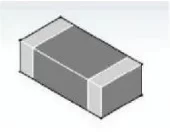
Side view of the component
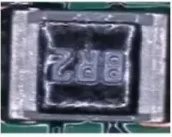
Front view of the component
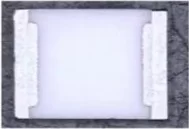
Inverted view of the component
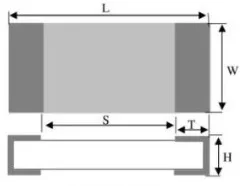
Dimensional drawing of the component
Dimension table of the component
Component type/resistance | Length (L) | Width (W) | Thickness (H) | Weld end length (T) | Inside distance of weld end (S) |
0201(1005) | 0.60 | 0.30 | 0.20 | 0.15 | 0.30 |
0402(1005) | 1.00 | 0.50 | 0.35 | 0.20 | 0.60 |
0603(1608) | 1.60 | 0.80 | 0.45 | 0.35 | 0.90 |
0805(2012) | 2.00 | 1.20 | 0.60 | 0.40 | 1.20 |
1206(3216) | 3.20 | 1.60 | 0.70 | 0.50 | 2.20 |
1210(3225) | 3.20 | 2.50 | 0.70 | 0.50 | 2.20 |
Solder requirements for chip component solder joints: including resistance (row resistance), capacitance (row capacity), inductance, etc
Lateral offset
Side offset (A) is less than or equal to 50% of the component's solderable end width (W) or 50% of the pad, whichever is smaller (determining factor: placement coordinate pad width)
End offset
End offset must not exceed the pad, (determining factor: placement coordinate pad length and inner distance)
Solder end and pad
The solder end must contact with the pad, the proper value is the solder end completely on the pad. (Determining factor: the length of the pad and the inner distance)
Positive solder end solder joint on the minimum height of tin
Minimum solder joint height (F) is the smaller of 25% of the solder thickness (G) plus the height of the solderable end (H) or 0.5 mm. (Determining factors: stencil thickness, component solder end size, pad size)
Solder height on the front solder end
The maximum solder joint height is the solder thickness plus the height of the solderable end of the component. (Determining factors: stencil thickness, component solder end size, pad size)
The maximum height of the frontal solder end
Maximum height can exceed the pad or climb to the top of the solderable end, but can not touch the component body. (Such phenomena occur more in 0201, 0402 class components)
Side solder end length
The best value side solder joint length is equal to the length of the solderable end of the component, the normal wetting of the solder joint is also acceptable. (Determining factors: stencil thickness, component solder end size, pad size)
Side solder end height
Normal wetting.
Chip component pad design: including resistance (resistance), capacitance (capacitance), inductance, etc
According to the component size and solder joint requirements to derive the following pad size:
Schematic diagram of chip component pads
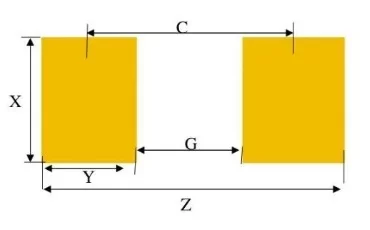
Chip component pad size table
Component type/ resistance | Length (L) | Width (W) | Inside distance of weld end (S) |
0201(1005) | 0.35 | 0.30 | 0.25 |
0402(1005) | 0.60 | 0.60 | 0.40 |
0603(1005) | 0.90 | 0.60 | 0.70 |
0805(2012) | 1.40 | 1.00 | 0.90 |
1206(3216) | 1.90 | 1.00 | 1.90 |
1210(3225) | 2.80 | 1.15 | 2.00 |
Chip component stencil opening design: including resistance (row resistance), capacitance (row capacity), inductance, etc.
0201 class component stencil design
Design points: components can not float high, tombstone
Design method: net thickness 0.08-0.12mm, open horseshoe shape, the inner distance to maintain 0.30 total under the tin area of 95% of the pad.
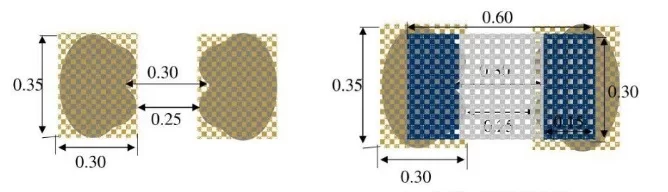
Left: Stencil under the tin and pad anastomosis diagram, right: component paste and pad anastomosis diagram
0402 class components stencil design
Design points: components can not float high, tin beads, tombstone
Design mode:
Net thickness 0.10-0.15mm, the best 0.12mm, the middle open 0.2 concave to avoid tin beads, the inner distance to maintain 0.45, resistors outside the three ends plus 0.05, capacitors outside the three ends plus 0.10, the total under the tin area for the pad of 100%-105%.
Note: The thickness of the resistor and capacitor are different (0.3mm for the resistor and 0.5mm for the capacitor), so the amount of tin is different, which is a good help to the height of the tin and the detection of AOI (automatic optical inspection).
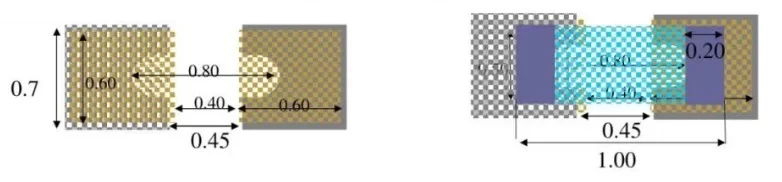
Left: Stencil under the tin and pad anastomosis diagram, right: component paste and pad anastomosis diagram
0603 class components stencil design
Design points: components to avoid tin beads, tombstone, the amount of tin on
Design method:
Net thickness 0.12-0.15mm, the best 0.15mm, the middle open 0.25 concave avoid tin beads, the inner distance to maintain 0.80, resistors outside the three ends plus 0.1, capacitors outside the three ends plus 0.15, the total under the tin area for the pad of 100%-110%.
Note: 0603 class components and 0402, 0201 components together when the stencil thickness is limited, in order to increase the amount of tin must take the additional way to complete.
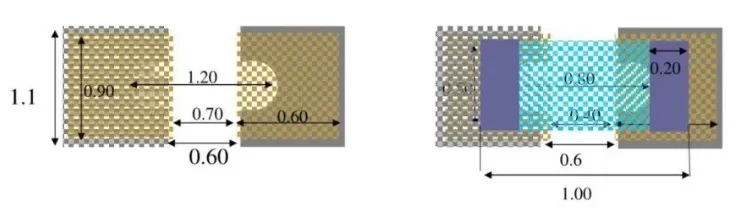
Left: Stencil under the tin and pad anastomosis diagram, right: component solder paste and pad anastomosis diagram
Stencil design for chip components with size larger than 0603 (1.6*0.8mm)
Design points: components to avoid tin beads, the amount of tin on
Design method:
Stencil thickness 0.12-0.15mm, best 0.15mm. 1/3 notch in the middle for avoiding tin beads, 90% of the lower tin volume.
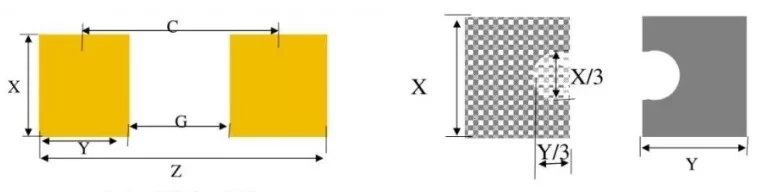
Left: Stencil under the tin and pad anastomosis diagram, right: 0805 above components stencil opening schematic
-20251124061922.webp "New Energy Vehicle Charging Pile PCBA")