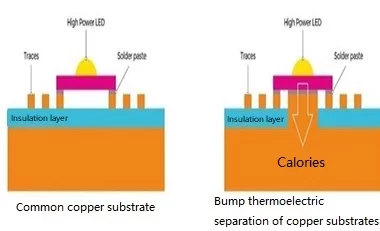
The copper substrate to do thermoelectric separation refers to a production process of copper substrate is a thermoelectric separation process, its substrate circuit part and thermal layer part in different line layers, the thermal layer part directly contact with the lamp bead heat dissipation part, to achieve the best heat dissipation thermal conductivity (zero thermal resistance).
Metal core PCB materials are mainly three, aluminum-based PCB, copper-based PCB, iron-based PCB. with the development of high-power electronics and high-frequency PCB, heat dissipation, volume requirements are increasingly high, the ordinary aluminum substrate can not meet, more and more high-power products in the use of copper substrate, many products on the copper substrate processing process requirements are also increasingly high, so what is the copper substrate, copper substrate has What are the advantages and disadvantages.
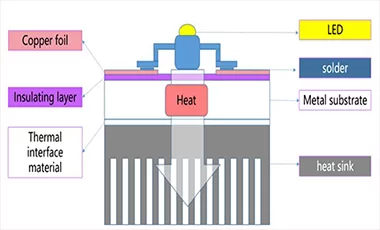
We first look at the above chart, on behalf of the ordinary aluminum substrate or copper substrate, heat dissipation needs to be insulated thermal conductive material (purple part of the chart), processing is more convenient, but after the insulating thermal conductive material, the thermal conductivity is not so good, this is suitable for small power LED lights, enough to use. That if the LED beads in the car or high-frequency PCB, heat dissipation needs are very large, aluminum substrate and ordinary copper substrate will not meet the common is to use thermoelectric separation copper substrate. The line part of copper substrate and the thermal layer part are on different line layers, and the thermal layer part directly touches the heat dissipation part of the lamp bead (such as the right part of the picture above) to achieve the best heat dissipation (zero thermal resistance) effect.
Advantages of copper substrate for thermal separation.
1. The choice of copper substrate, high density, the substrate itself has a strong thermal carrying capacity, good thermal conductivity and heat dissipation.
2. The use of thermoelectric separation structure, and lamp bead contact zero thermal resistance. Maximum reduction of lamp bead light decay to extend the life of the lamp beads.
3. Copper substrate with high density and strong thermal carrying capacity, smaller volume under the same power.
4. Suitable for matching single high-power lamp beads, especially COB package, so that the lamps achieve better results.
5. According to different needs, various surface treatment can be carried out (sunken gold, OSP, tin spray, silver plating, sunken silver + silver plating), with excellent reliability of surface treatment layer.
6. Different structures can be made according to different design needs of the luminaire (copper convex block, copper concave block, thermal layer and line layer parallel).
Disadvantages of thermoelectric separation copper substrate.
Not applicable with single electrode chip bare crystal package.
-20251124061922.webp "New Energy Vehicle Charging Pile PCBA")