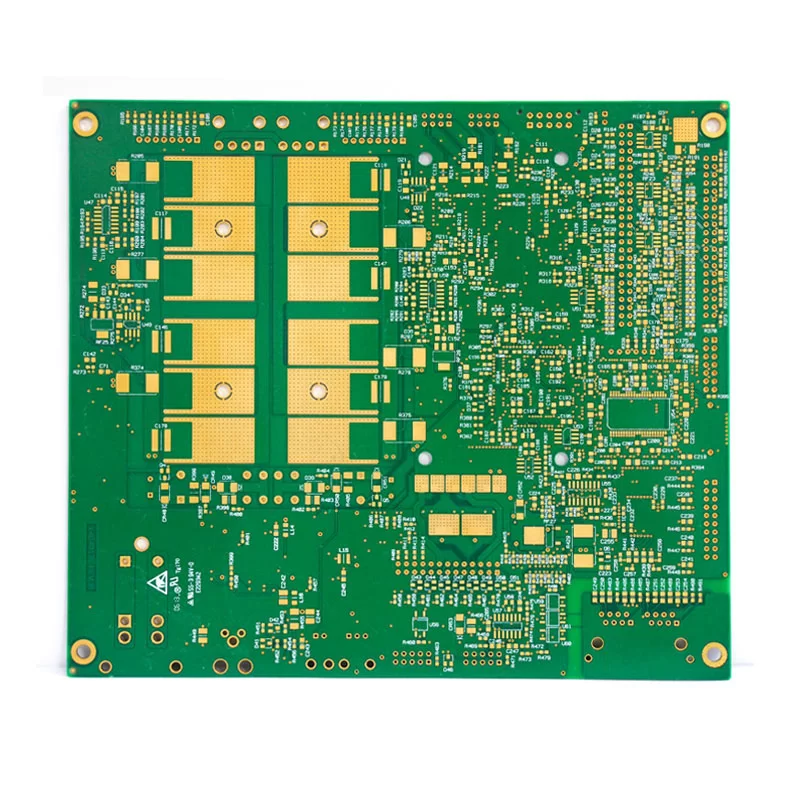
Solving Complexity in High-Frequency RF & Sensor Circuit Board Design
Developing next-generation telecommunications, medical devices, and automotive electronics comes with a critical challenge: maintaining pristine signal integrity. As operational frequencies climb and form factors continuously shrink, engineers find themselves battling impedance mismatches, electromagnetic interference (EMI), and devastating signal loss. When sensitive data and real-time sensor processing are on the line, you need a fabrication partner that understands these microscopic variables deeply.
This is where our targeted expertise changes the equation. Equipped with state-of-the-art manufacturing and testing capabilities, HUB Circuits provides a one-stop solution from rapid prototyping to final assembly. By mastering the nuances of High-Frequency RF & Sensor Circuit Board Design, we bridge the gap between theoretical schematics and flawless physical execution. Our ISO 9001 certified and UL recognized facilities handle high-mix, low-to-medium volume runs with exceptional speed. Whether your project demands complex 1-32 layer stack-ups or high-density interconnection (HDI), we ensure your mission-critical applications reach the market faster without ever compromising on safety or quality.
Engineering Standards for High-Frequency RF & Sensor Circuit Board Design
Precision is non-negotiable when dealing with high-speed signals and sensitive sensor arrays. To guarantee superior performance across industrial control and telecommunication networks, strict adherence to specialized fabrication tolerances must be maintained. Below is an outline of how our facility benchmarks key production metrics against industry demands.
| Performance Metric | Industry Significance | Our Engineering Standard | Advantage |
|---|---|---|---|
| Layer Scalability & HDI | Crucial for complex routing and electromagnetic shielding in tight spaces. | 1-32 layers, including specialized HDI, Flexible, and Rigid-Flex boards. | Provides ultimate design flexibility for dense interconnections without expanding the footprint. |
| Trace Geometry Control | Ensures accurate RF trace impedance and minimizes reflection. | Ultra-fine line width and spacing execution. | Prevents phase shifts, cross-talk, and signal attenuation in highly sensitive sensor arrays. |
| Surface Topography | Critical for solderability and mitigating the high-frequency skin effect. | Advanced, flat surface finishes tailored for RF profiles. | Optimizes high-frequency signal propagation and ensures long-term environmental durability. |
| Quality Validation | Validates that theoretical designs survive real-world stressors. | Advanced automated testing, fully ISO 9001 & UL compliant. | Guarantees product safety, regulatory compliance, and near-zero defect rates prior to assembly. |
Maximizing ROI with High-Frequency RF & Sensor Circuit Board Design
Strategic component sourcing goes far beyond technical specifications; it is a fundamental driver of your project’s overall financial success. Partnering with a facility that seamlessly integrates manufacturing and assembly significantly reduces costly delays. By leveraging our robust rapid prototyping capabilities and characteristically short lead times, your engineering team can iterate faster, effectively eliminating the expensive cycle of late-stage design failures.
Furthermore, our established global footprint—supplying demanding sectors from medical devices to automotive electronics—means your investment in High-Frequency RF & Sensor Circuit Board Design benefits from proven operational efficiency. This integrated approach translates directly into lower overall production costs, higher initial yield rates, and an accelerated path to revenue realization. The data below illustrates the projected performance gains when transitioning to an optimized fabrication strategy.
Related products
Top Selling Products
-20251124032908.webp "Car Charger PCBA")
Choosing a Reliable PCB Manufacturer for High Performance Electronics
Comprehensive Guide to Printed Circuit Board Design and Fabrication

123456Modern Printed Circuit Board Design and Global Manufacturing Trends123123123